

Concealment as Statecraft
The Theological Foundations of Iranian Strategic Deception

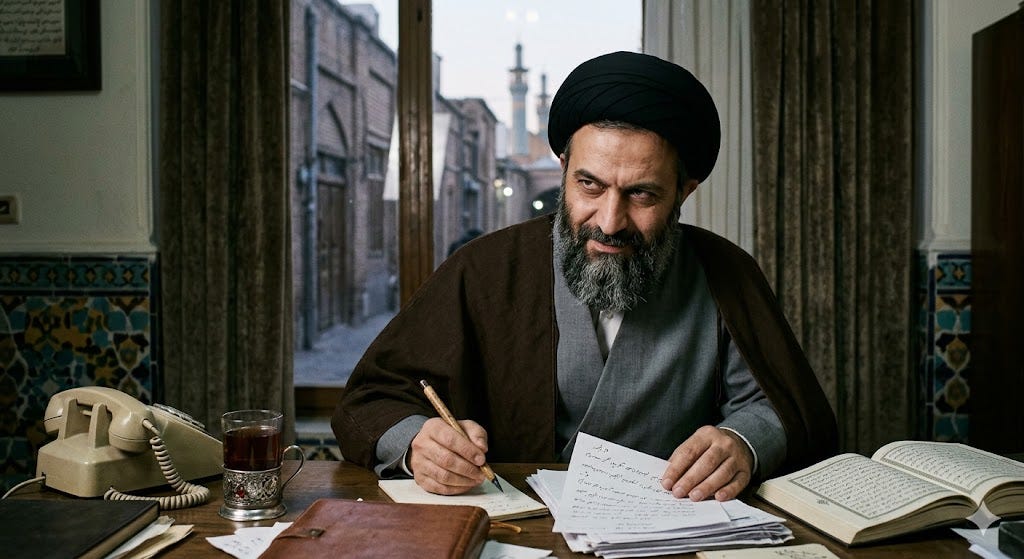
On June 9th, I presented a topic that served as my first PhD thesis. Regular readers will know this blog focuses primary on the infamous Illegals program of the Russian Intelligence Services. But, also top of the list of my intellectual curiosity is Iranian regime deception techniques and tactics. I present the paper in full for readers here.
- Omid June 12 2026
Department of War Studies, King’s College London
Prepared for New Directions in the History of War — the Annual Graduate Conference of the University of Oxford and the Sir Michael Howard Centre for the History of War, King’s College London, 9 June 2026
Abstract. On 28 February 2026, American and Israeli munitions destroyed much of Iran’s declared nuclear infrastructure and established clear tactical and operational dominance. Within weeks Tehran had buried the tunnel entrances at Isfahan, transferred supreme authority to Mojtaba Khamenei, and returned to the negotiating table in Islamabad. The kinetic war was decisive; the information war was not. This paper argues that the Islamic Republic of Iran conducts strategic deception not as Western militaries do—through doctrinally bounded information and psychological operations governed by published doctrine and the law of armed conflict—but through a sacralized framework that renders dissimulation a sovereign religious obligation. Two classical Shia doctrines underwrite that framework. Taqiyya, reformulated by Ruhollah Khomeini in his 1953 Risāla-ye Taqiyya as the protection of the Islamic state itself, was operationalized by Ali Khamenei in 1990 as a battlefield instrument. Maslahat-e nezām, institutionalized through the 1988 Expediency Council, grants the Supreme Leader the theological authority to suspend Islamic law for the survival of the system. Where NATO psychological operations must be truthful in attribution and tied to a defined military objective, Iranian khod’eh—strategic misdirection—carries divine sanction and recognizes no such limit. Reading four cases against one another (the nuclear fatwa, the domestic economy of piety, the export of revolution, and the persecution of the Baháʼí Faith), the paper contends that Western analysts and media persistently misread theological deception as diplomatic ambiguity, and pay strategic costs accordingly.
Keywords: Iran; strategic deception; taqiyya; maslahat; khod’eh; information operations; military deception; nuclear diplomacy; Baháʼí
Introduction: The Information War That Was Not
Deception is as old as war. “All warfare is based on deception,” Sun Tzu wrote two and a half millennia ago; the Greeks took Troy with a wooden horse rather than a frontal assault; and in 1944 an elaborate Allied fiction held the German armor at the Pas-de-Calais while the landings came ashore in Normandy.[1] To study war seriously, as Michael Howard insisted across a long career, is to study it “in width, in depth, and in context”—to resist the temptation to reduce a human and cultural phenomenon to its technical surface.[2] This paper takes that injunction as its method, and asks a question the events of early 2026 made unavoidable: when the Islamic Republic of Iran deceives, what exactly is it doing, and why do its Western interlocutors so reliably misread it?
The occasion is recent and stark. On 28 February 2026, American and Israeli munitions destroyed much of Iran’s declared nuclear infrastructure and achieved unambiguous tactical and operational dominance. The regime’s physical response was almost confessional in its priorities. Within weeks, Tehran had buried the tunnel entrances at the Isfahan complex, transferred supreme authority to Mojtaba Khamenei in a quiet dynastic manoeuvre, and—having absorbed the blow—returned to the negotiating table in Islamabad.[3] The kinetic war was decisive. The information war was not. The same state that had just lost its centrifuge halls continued to contest the battle over meaning: what the strikes signified, what Iran had intended, whether its nuclear restraint had ever been real.
That continuity is the puzzle. To diplomats and policy analysts the Islamic Republic has always seemed erratic, lurching between pragmatic engagement and uncompromising revolutionary zeal.[4] I argue that the apparent incoherence dissolves once the regime’s conduct is read through the Twelver Shia jurisprudence its founders deliberately repurposed for the state. Three concepts do most of the work. Taqiyya is sacred concealment; maslahat is regime expediency elevated to a religious absolute; khod’eh is strategic misdirection sanctioned, in the regime’s reading, by the Prophet himself. Together they constitute not a set of tactics but an operating system—one that frees the state from the moral and legal constraints binding both orthodox Islamic law and the secular international order.[5]
The argument is comparative, and the comparison is the point. Western militaries deceive too, and prolifically. But they deceive within doctrine. United States military deception is governed by Joint Publication 3-13.4; information and psychological operations by JP 3-13.2; NATO’s equivalents by Allied Joint Publication 3.10. Each is bounded by policy, by a defined and observable military objective, and—above all—by the law of armed conflict, which forbids perfidy and requires that psychological operations be truthful in attribution.[6] The Islamic Republic recognizes no such boundary. Its deception is sacralized rather than instrumentalized; it answers not to a campaign plan but to maslahat, the survival of the system, which the state has defined as identical to the survival of Islam itself. Where NATO psychological operations must be truthful, Iranian khod’eh need not be. That is the decisive difference, and missing it is expensive.
The paper proceeds in five movements. It first recovers the theological and historical lexicon of concealment and the Khomeinist rupture that weaponized it. It then sets the regime’s doctrine against published Western and Israeli practice, arguing that the crucial contrast is not deception versus honesty but bounded deception versus unbounded. It reads four cases against one another—lying to the world, lying to its own people, exporting the revolution, and persecuting those who refuse to lie. It examines how the regime reads a treaty, and what its sacred idiom shares with a more familiar twentieth-century model of permanent emergency. Finally, it asks what it would mean to read the deception correctly—and what the regime pays, at home, for a shield that works abroad.
II. The Lexicon of Concealment
The political uses of taqiyya cannot be understood apart from its origins, because the regime’s authority rests precisely on the claim that it is doing nothing new. The word derives from the Arabic triliteral root w-q-y, carrying the senses of caution, fear, prudence, and guarding against danger; it is cognate with taqwā, the piety that sits near the centre of Islamic ethics.[7] In classical Twelver jurisprudence, taqiyya denotes the religiously sanctioned concealment of one’s beliefs under mortal threat or grave compulsion—a permission, and at times an obligation, to profess outwardly what one does not hold inwardly in order to survive. Its founding precedent is the case of Ammar ibn Yasir, the early companion whose parents were tortured to death by the Quraysh and who, under that duress, outwardly renounced his faith; the renunciation was subsequently legitimized by revelation, fixing the principle that compliance under threat does not negate belief.[8]
For the better part of a millennium taqiyya did exactly the conservative work it was designed to do. The Shia were a frequently persecuted minority under dominant Sunni empires—Umayyad, then Abbasid—and after the occultation of the Twelfth Imam in 874 their clerical establishment settled into political quietism: any state raised before the Mahdi’s return was illegitimate, and the believer’s task was patience, not rebellion.[9] Concealment, in this world, was defensive and tightly circumscribed—licit only when life, property, or honor were directly imperilled, and forbidden where it would corrupt the religion or shed innocent blood.[10] The dictum attributed to the sixth Imam, Jafar al-Sadiq—“Taqiyya is my religion and the religion of my forefathers; one who does not practice it has no religion”—captures how thoroughly survival had been woven into Shia identity.[11]
Two further concepts complete the inherited vocabulary. Khod’eh—strategic deception—drew its legitimacy from a tradition ascribed to the Prophet and cited across both Sunni and Shia hadith: al-ḥarb khudʿa, “war is deception.”[12] In its classical form this licensed ruse against an enemy on the battlefield, and nowhere else. Maslahat—expediency, or the public interest—was, if anything, a Sunni inheritance, developed by jurists such as al-Ghazali to keep the literal application of the law from working against the welfare it was meant to serve.[13] None of the three, in its received form, authorized a state to lie to its own people, to fabricate a religious decree for foreign consumption, or to suspend the pillars of the faith. That authorization had to be manufactured, and it was.
III. The Khomeinist Rupture: From Shield to Sovereign Instrument
The rupture was epistemological before it was political. It is worth saying at once that Khomeini did not invent the guardianship of the jurist; its political dimension had been articulated more than a century earlier by Mulla Ahmad Naraghi, and the bare doctrine reaches back further still. What Khomeini did was radicalize it. In Kashf al-Asrār in the 1940s and, fully, in his 1970 Najaf lectures published as Ḥokumat-e Eslāmī, he overturned the quietist consensus by arguing that the jurists are the “fortresses of Islam,” charged with an active, divinely mandated duty to govern as deputies of the Hidden Imam.[14] At a stroke the state ceased to be a temporal administrator awaiting the Mahdi and became the physical manifestation of divine will on earth. The consequence was the load-bearing premise of everything that followed: to preserve the state was to preserve Islam.[15] Defensive doctrines could now be retooled as offensive and diplomatic instruments without any sense of contradiction, because the telos had changed.
Khomeini supplied the specific reinterpretation of taqiyya himself. In his 1953 treatise Risāla-ye Taqiyya he reasoned that the obligation’s underlying purpose was the preservation of the religion rather than its passive erasure, and on that basis expanded it far beyond personal self-protection: concealment became obligatory whenever it served the broader good, the advance of the revolutionary movement, or the establishment of an Islamic state.[16] He distinguished taqiyya khawfiyya, the old fear-based concealment, from taqiyya mudārātiyya, a “polite” or managed dissimulation—tactical cooperation, the curation of appearances. The distinction matters, because it is the second kind that travels into statecraft.[17]
The clearest proof that taqiyya had become an instrument rather than a commandment is that Khomeini switched it off when it suited him. In March 1963, after the Shah’s forces stormed the Fayziyeh seminary in Qom, traditional clerics counselled the customary silence. Khomeini did the opposite. “The Quran and religion are in danger,” he declared; “with this probability, taqiyya is forbidden, and the manifestation of truths is obligatory, whatever may come.”[18] Concealment, in other words, was a lever—engaged for survival, disengaged for revolution, and re-engaged, once the state existed, as foreign policy. A doctrine that can be commanded and forbidden by the same man within a single career is not an immutable obligation. It is a tool.
The institutional capstone came in 1988. Adjudicating a long deadlock in which the conservative Guardian Council kept striking down the parliament’s economic legislation as a violation of Sharia property protections, Khomeini issued, in a letter to then-president Khamenei, the doctrine of velāyat-e moṭlaqa-ye faqīh, the absolute guardianship of the jurist. The state, he wrote, is “one of the primary injunctions of Islam and has priority over all secondary injunctions, even prayer, fasting, and Hajj,” and “can unilaterally revoke the religious contracts it has made with the people when that contract is against the interests of the country and Islam.”[19] This is the hinge of the whole system. If the ruler may suspend the pillars of the faith for the welfare of the state, then no commitment the state makes—least of all to a foreign power—can be more than provisional.
From this premise Khomeini drew the formula that became the regime’s internal creed: ḥefẓ-e neẓām az oujab-e wājebāt ast, the preservation of the system is the most obligatory of obligations.[20] The phrase performs a remarkable conjuring trick. It places the state above ethical or theological audit, so that any act undertaken to ensure its survival—however violent, however deceptive—is sanctified in advance. Its most infamous application was immediate. In the summer of 1988, with the Iran–Iraq war ending in exhaustion and the Mojahedin-e Khalq mounting an incursion, Khomeini ordered the extrajudicial execution of thousands of political prisoners; the killings were framed not as a purge but as a religious duty to defend the fortress of Islam.[21] To give the principle a permanent home, he created the Expediency Discernment Council in 1988, later chaired by the arch-pragmatist Hashemi Rafsanjani, with explicit authority to set aside Sharia and the constitution where the interest of the system required it.[22] As one clerical critic observed of the result, in classical thought truth is the absolute and maslahat the temporary exception—but in the architecture of the Islamic Republic the exception has become the permanent governing rule.[23]
IV. The Doctrinal Engine: Taqiyya, Maslahat, and Khod’eh
It is worth setting the three concepts side by side, because their division of labor is precise. Maslahat supplies the end—survival—and the authorization to pursue it by any means. Taqiyya supplies the defensive method, the shield. Khod’eh supplies the offensive method, the sword. Table 1 maps each from its classical meaning to its operational form in the contemporary state.
Table 1. The theological triad: classical origins and modern statecraft.
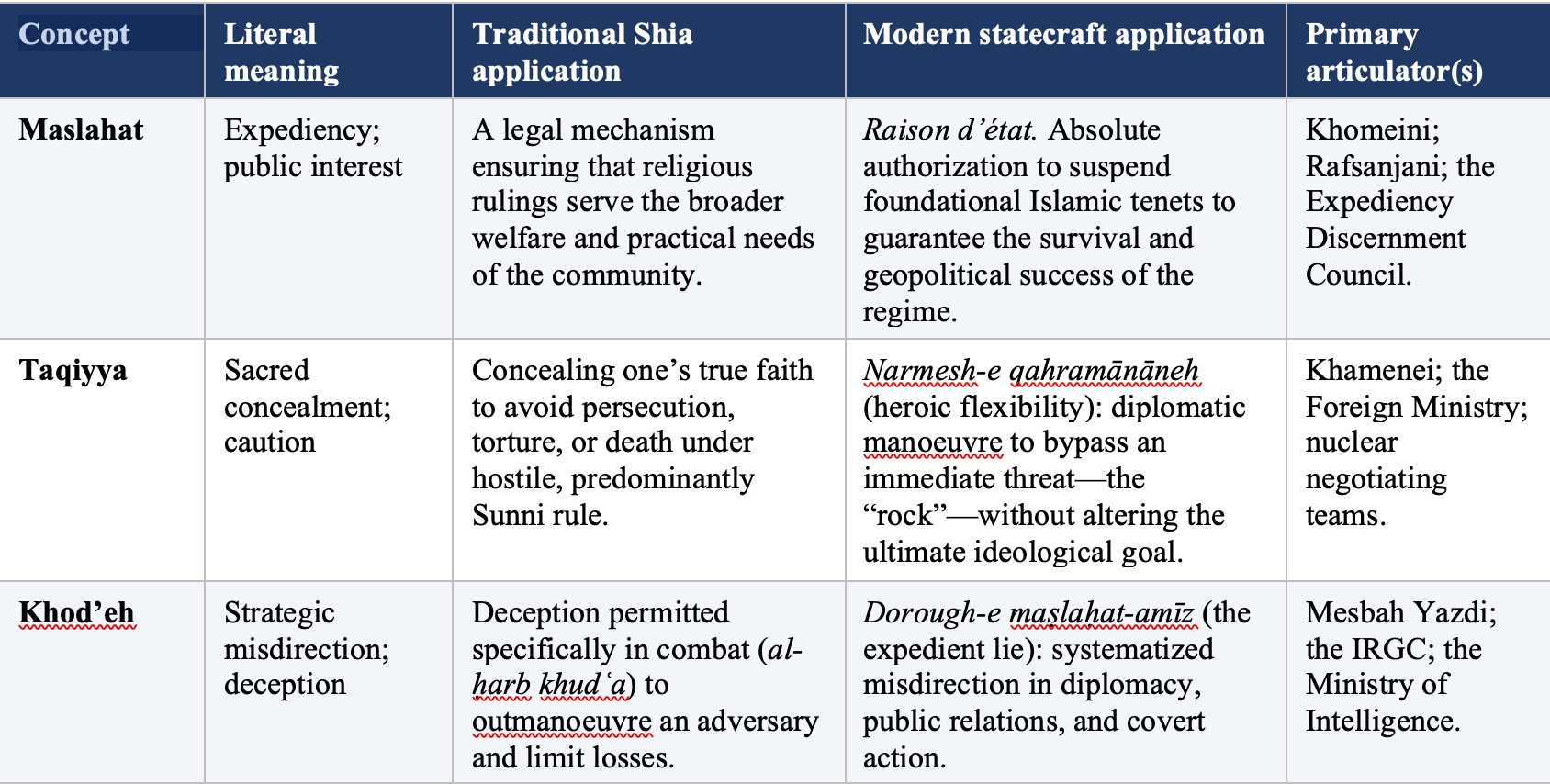
Sources: compiled by the author from Persian clerical texts and the studies cited below.
The reformulation of taqiyya as a weapon, rather than a refuge, is Khamenei’s signal contribution. In a 1990 address on statecraft he attacked the domestic assumption that taqiyya was a relic of Shia weakness, useful only to a minority hiding from empire. A shield, he said, is not something one uses while cowering under a blanket; it “belongs in the midst of warfare, during the clash of swords.” Properly wielded, taqiyya strikes the enemy “so that he neither sees the sword, nor the hand holding the sword, nor its raising, nor its descent … he only feels the pain.”[24] The image repays dwelling on, because it is not the language of concealment-as-survival at all. It is the language of the ambush. Strategic deniability, covert action, diplomatic obfuscation—these are recast as religiously sanctioned acts of war, conducted from behind a shield the adversary cannot see.
Maslahat, for its part, dissolves the last constraint: the truth. Rafsanjani put the equation plainly—the expediency of the Iranian regime is, in its own eyes, identical to that of the entire Islamic nation, so that the regime’s defeat would be a catastrophe for Islam as such.[25] Once survival is sacred and survival requires deception, deception is sacred too. The regime’s hardline theorists were unembarrassed about saying so. The late Mohammad-Taqi Mesbah Yazdi—intellectual godfather of the security establishment—built a formal defense of the dorough-e maṣlaḥat-amīz, the expedient lie, on a couplet of the poet Saadi: an expedient lie is better than a mischief-making truth. Invoking the juristic rule of al-aham wa’l-muhimm, the preference of the more important over the merely important, he argued that because the Islamic state embodies God’s truth on earth, a falsehood spoken in its defense is stripped of sin and converted into duty.[26] Khomeini had said as much in 1981, and more bluntly: for the preservation of Islam and of Muslim lives, “lying is also obligatory … when Islam is in danger … it is obligatory upon you to lie.”[27]
There is a revealing paradox here, and it is not hypocrisy so much as a window onto the regime’s self-understanding. In April 1964 Khomeini had publicly ridiculed the cynic’s definition of politics as “lying, trickery, deception, cunning”; he insisted that genuine Islamic politics required none of it, and that “all of Islam is politics.”[28] He was not, by his own lights, contradicting himself when he later sanctified the lie. To the regime there is no tension between purity and deception, because deception in defense of the sacred state is purity. That is precisely what makes the doctrine so resistant to the ordinary Western expectation that exposure—catching a regime in a falsehood—carries a cost. Exposure presumes a shared norm against lying. The Islamic Republic does not share it.
V. Deception with a Payoff, and Deception without One
This is the point at which the historian of war must insist on a distinction the policy debate routinely blurs. The objection to Iranian conduct is not that the regime deceives; every competent military deceives. The objection is that Iran’s deception is unbounded where the Western practice it is measured against is bounded—and, paradoxically, that boundedness is what makes Western deception effective.
Consider the doctrine. United States military deception, codified in Joint Publication 3-13.4, is defined entirely by its effect on an adversary’s behavior: it requires a target decision-maker, a stated objective, and an observable action the enemy is to be induced to take.[29] Belief is not the goal; behavior is. A deception that makes the enemy believe something but do nothing has, by doctrine, failed. Psychological and information operations under JP 3-13.2 and NATO’s AJP-3.10 are bounded differently but no less firmly: they must be truthful in attribution—the source may not be disguised as the enemy’s own—and they operate within the law of armed conflict, which permits ruses but prohibits perfidy.[30] Table 2 sets each Shia concept beside its nearest Western analogue and names the decisive difference in each case.
Table 2. Shia concepts and their bounded Western doctrinal analogues.
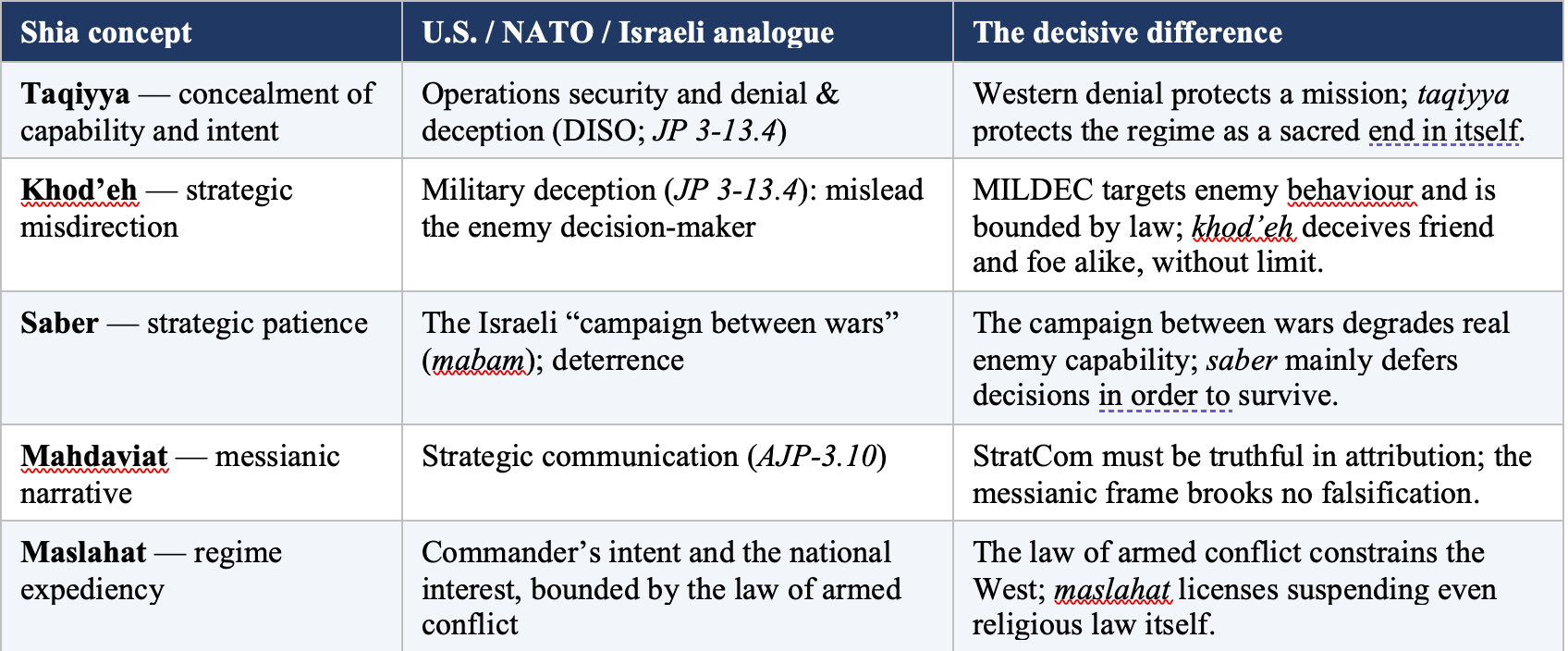
Sources: U.S. and NATO information-operations doctrine (JP 3-13.4, JP 3-13.2, AJP-3.10); INSS analyses of the Israeli “campaign between wars.” Compiled by the author.
The empirical record of bounded deception is formidable. During Operation Desert Storm, American psychological operations were tied throughout to a single measurable end—enemy capitulation. Coalition aircraft dropped on the order of twenty-nine million leaflets, seen by an estimated ninety-eight per cent of the Iraqi prisoners eventually taken; more than eighty-seven thousand Iraqi troops surrendered and some seventeen thousand defected; on Faylaka Island an entire garrison of more than fourteen hundred men surrendered to a circling loudspeaker aircraft without a shot fired.[31] Deception and influence were decisive here precisely because they were yoked to behavior: a surrender, a desertion, a mistimed reserve, a flank left open.
The Iranian model inverts the doctrine. It produces maximum signaling and minimal effect. The clearest illustration is Operation True Promise of April 2024, the regime’s retaliation for the Israeli strike on its Damascus consulate. More than three hundred drones and missiles were launched—and telegraphed days in advance, through intermediaries, so that almost all were intercepted. At home the barrage was hailed as a “regret-inducing slap.” On the battlefield it changed nothing, and was designed to change nothing: posture demanded an answer, and saber—strategic patience—demanded that the answer alter no reality.[32] This is deception as theatre rather than as maneuver. It has no target decision-maker abroad and no observable objective beyond the management of perception, and the perception it most needs to manage is domestic.
Hence the asymmetry that I take to be the analytic heart of the matter. Western military deception spends an enemy’s certainty in order to win a battle. Iranian posturing spends its own people’s certainty in order to win a news cycle. The first is an investment with a measurable return. The second is a slow liquidation of the one asset that repression cannot manufacture—the credibility of the state in the eyes of the governed. A fabricated fatwa, a buried defeat, a victory no one believes: each is a spent coin of trust, and the treasury is not infinite.
VI. Four Cases
The doctrine is best tested where it touches the ground. I read four cases against one another not because each is individually novel—several are well documented—but because together they expose the single logic beneath very different conduct. The regime lies to the world about its bomb, to its own people about its plunder, and to the region through its proxies; and, most revealingly, it persecutes the one community that refuses to lie at all.
A. Lying to the World: The Nuclear Fatwa That Never Was
For two decades the centerpiece of Iran’s diplomatic defense was a religious decree. Diplomats and apologists insisted that Khamenei had issued a binding fatwa forbidding the production, stockpiling, and use of nuclear weapons, and the claim was repeated by Western leaders as an objective, theological guarantee of peaceful intent.[33] The trouble is that the man who built the narrative has explained how it was built. Hassan Rouhani, Iran’s chief nuclear negotiator in the early 2000s and later president, recounted in a 2012 interview with the monthly Mehrnameh that during talks with the European foreign ministers in 2004 he had, on his own initiative and without prior coordination with the Supreme Leader, recast remarks from a Friday sermon as a binding “leadership fatwa” in order to win the confidence of the Europeans.[34] A 2024 Atlantic Council study, tracking Khamenei’s statements across twenty years, reached the blunt conclusion that he had never in fact issued a fatwa against building a nuclear weapon.[35]
The text supports the suspicion. Where Iranian diplomacy marketed the fatwa as a blanket prohibition, Khamenei’s own formulations—including the message to the 2010 disarmament conference often cited as the decree itself—deploy the word harām almost exclusively against the use of weapons of mass destruction, not their production or possession.[36] Condemning use while leaving development untouched is not an oversight; it is the linguistic architecture of a threshold capability, religiously consistent and strategically empty. And under absolute guardianship the decree is in any case revocable, because nothing stands above maslahat. After the direct exchanges with Israel in 2024 and 2025, regime figures said so openly: the commander responsible for nuclear-site security floated a “revision” of doctrine if the sites were struck; Khamenei’s adviser Kamal Kharrazi warned that an existential threat would leave Iran “no choice but to change our military doctrine”; a hardline parliamentarian boasted the country was “a week away” from a test on the Leader’s word; and senior officers reportedly told Khamenei it might be the regime’s last chance to obtain a weapon before it was too late.[37] The fatwa, in short, was a sentence, not a wall.
Behind the narrative the machine kept building. The Islamic Republic has consistently treated agreements—the 2004 Paris accord, the 2015 Joint Comprehensive Plan of Action—not as settlements but as technically reversible pauses.[38] After the American withdrawal in 2018 it breached the caps in sequence, installing advanced IR-6 centrifuges, raising enrichment, and demonstrating that the infrastructure for a rapid breakout had been preserved intact at Natanz, in the bunkered halls at Fordow carved into a mountain near Qom, and at the conversion plant at Isfahan, while restricting inspector access to suspected weaponization sites such as Parchin.[39] By mid-2025 Iran held more than four hundred kilograms of uranium enriched to sixty per cent—a short technical step from weapons grade, and enough, if further refined, for several devices.[40] The coexistence of a narrative of peace with a fortified and expanding capability is the physical signature of state-level taqiyya: diplomacy to relieve the pressure, concealment to advance the programme, and a fatwa to make the concealment sound holy.
B. Lying to Its Own People: Piety as a Veil for Plunder
Taqiyya turned inward is the least examined and most corrosive of its uses. The regime demands strict Islamic virtue from the public while a praetorian elite runs a shadow economy, and it reframes the resulting hardship as the cruelty of foreign sanctions rather than the cost of domestic predation.[41] The scale of that predation is not marginal. Estimates of the share of Iran’s economy under the control of the Islamic Revolutionary Guard Corps range from roughly a third to as much as two-thirds; fuel smuggling alone is thought to drain well over ten billion dollars a year; and a substantial fraction of all imports moves through quasi-official channels beyond the reach of competition or audit.[42] Rouhani himself, no dissident, complained in 2017 that a part of the economy once held by an “unarmed government” had been handed to “an armed government,” with the result that “no one dares compete with them.”[43]
The cruelty is in the detail. The same Guard Corps that profits from smuggling polices the border against it, and along the Kurdish frontier its forces routinely shoot the impoverished kolbar porters who carry contraband on their backs—killing the smallest participants in a trade the institution itself runs at scale.[44] When that order is challenged, the regime reaches for the expedient lie as a matter of course. During the 2009 Green Movement and the 2022 protests that followed the death in custody of Mahsa Amini, the state systematically falsified casualty figures and the identities of the dead, deployed bohtan—fabricated moral, financial, or sexual charges—against opponents, and prosecuted dissent itself as moḥārebeh, waging war against God.[45] The theological move is the same one that sanctifies the lie abroad: opposition to a sacred state is not crime but apostasy, and against apostasy almost anything is permitted.
C. Exporting the Revolution: Plausible Deniability as Doctrine
Outward projection rests on a messianic premise. Mahdaviat—the belief in the return of the Twelfth Imam—was, before the revolution, a doctrine of patience; Khomeini transformed it into a doctrine of action, in which believers must actively prepare the ground for the return by building the Islamic state and confronting global oppression.[46] Cast as the umm al-qurā, the mother-city of the Islamic world, Iran could equate the defense of its own state with the defense of the faith and project power outward as a sacred duty.[47] Lacking the conventional strength to confront the United States or Israel directly, it built “strategic depth” through proxies—Hezbollah in Lebanon, the Houthis in Yemen, Kataib Hizballah and allied militias in Iraq and Syria, Hamas and Islamic Jihad in Gaza—arming and directing them while disclaiming the hand that did so. Deniability here is not a convenience; it is taqiyya and khod’eh in operational form, a way to wage war while presenting the militias as independent actors and shielding Iranian territory from direct reprisal.[48]
The emotional fuel is Karbala. The martyrdom of Imam Hussein before the army of the Umayyad caliph Yazid in 680 sits at the moral center of Shia Islam, and after 1979 the state systematically cast itself as Hussein’s righteous camp and its adversaries—the United States as the “Great Satan,” Israel beside it—as the modern Yazid. The narrative converts isolation and economic pain into a spiritual trial and a mark of distinction, and it complicates Western deterrence at the root, because a doctrine in which even military defeat can be a moral victory does not respond to the cost-benefit calculus that deterrence assumes.[49] Crucially, the regime balances this religious register with Persian nationalism, fusing the glory of Persepolis with the zeal of Karbala so that even secular Iranians can be mobilized in defense of the homeland.[50] The synthesis is deliberate, and it widens the coalition that the sacred idiom alone could not reach.
D. Suppressing the Truthful: The Mirror Image of the Baha’i
The most illuminating case is the one in which the regime confronts the photographic negative of its own creed. The Baháʼí Faith expressly forbids taqiyya. Where Shia jurisprudence permits and at times commands the concealment of belief, the Baha’i writings make truthfulness the cardinal virtue—“truthfulness,” in Baha’u’llah’s words, “is the foundation of all the virtues of the world of humanity”—and prohibit the believer from denying the faith to escape danger.[51] The break is doctrinal and old. At the Conference of Badasht in 1848 the Babis declared the abrogation of Islamic Sharia, a rupture dramatized when the poet Tahirih appeared unveiled; and on the first day of his declaration in the garden of Ridvan, Baha’u’llah annulled the law of the sword, holding that the faith must prevail “through wisdom and utterance” rather than coercion.[52] Where the Islamic Republic sacralizes both jihad and dissimulation, the Baháʼís revelation abrogated both.
The consequence inside Iran is exact and terrible. Because their faith forbids concealment, the country’s roughly three hundred thousand Baháʼís—its largest non-Muslim minority, and one with no constitutional recognition—cannot hide to escape persecution, and so they are persecuted in the open.[53] More than two hundred were killed by the state between 1978 and 1998; thousands have been imprisoned; some twelve hundred were subjected to legal proceedings or imprisonment in 2024 alone; they are barred from universities and public employment and have had property confiscated; and in November 2025 the European Parliament condemned the repression by 549 votes to seven.[54] The deepest irony is documentary. The persecution was set out in a confidential 1991 memorandum from the Supreme Revolutionary Cultural Council, signed by Khamenei, directing that the community’s “progress and development” be “blocked” and that Baháʼís “be expelled from universities … once it becomes known” that they are believers—a written policy denied in public even as it was enforced.[55]
Here concealment turns inward upon the regime’s own subjects: a state that lies to the world about its bomb conceals, in writing, its persecution of a community whose only offence is that it will not lie. The Baháʼís case is the control experiment of this paper. It shows that for the Islamic Republic dissimulation is not incidental but constitutive—so constitutive that truthfulness itself becomes a punishable threat.
VII. The Negotiating Table: Every Treaty Is a Truce
How the regime reads a treaty follows directly from how it reads its own scripture, and the governing model is a seventh-century one. The Treaty of Hudaybiyyah, concluded by the Prophet with the Quraysh of Mecca in 628, is remembered in the Iranian reading not as a transition to coexistence but as a ten-year truce struck from weakness, designed to buy time, isolate the adversary, and prepare the ground for the eventual conquest of Mecca.[56] Khamenei reaches for a second precedent as well: the peace that the second Imam, Hassan, made with the Umayyad Muawiyah in 661, which Khamenei—who before the revolution translated a book pointedly titled The Peace of Imam Hassan: The Most Magnificent Heroic Flexibility in History—reads as a masterclass in tactical retreat rather than surrender.[57] In both cases the accord is instrumental and the horizon is patient. The agreement holds only until the balance shifts.
The doctrine that operationalizes this for the foreign ministry is the tripartite formula Khamenei set out in 1989: ʿezzat, ḥekmat, and maslahat—dignity, wisdom, and expediency.[58] Dignity forbids negotiating from apparent submission; talks must always be staged as meetings of equals. Wisdom is frank tactical calculation: Khamenei has approvingly compared it to the Prophet’s expedient treaties with the Jewish tribes of Medina, proposing friendship to an adversary one fully expects to fight.[59] Expediency ensures that every move, advance or retreat, ultimately serves the survival of the system. From this comes the now-famous image of narmesh-e qahramānāneh, “heroic flexibility,” which Khamenei coined ahead of the JCPOA: the skilled wrestler may yield, step back, even show flexibility for technical reasons, but he never forgets who his opponent is.[60]
Khamenei has been explicit that this is taqiyya by another name. Addressing the foreign ministry in May 2023, he said that flexibility “has the exact same meaning that we gave to taqiyya,” and offered the metaphor that has since become a key to the regime’s diplomacy: “when you are moving somewhere and reach a rock you cannot cross, you find a path to bypass the rock … we did not go to war with the rock; we found flexibility, and we were able to find another path.”[61] The sentence repays close reading. The destination is unchanged; only the route bends. Western negotiators, working from the liberal-internationalist premise that engagement and integration will in time moderate a regime and bind it to the rules-based order, have repeatedly mistaken the bending of the route for a change of destination.[62] To the Islamic Republic a treaty is a path around a rock, and the rock—sanctions, isolation, an adversary’s momentary superiority—is precisely what the treaty is meant to circumvent. When the obstacle is gone, so is the flexibility.
VIII. A Sacred Veil over a Familiar Machine
If the theology is stripped away, the architecture that remains is not exotic at all. It is a one-party security state enforced by a praetorian guard, and its sacred idiom performs the same function that Marxism–Leninism performed for the Soviet state: it supplies an unfalsifiable justification for permanent emergency.[63] The comparison is not rhetorical decoration; it is analytically clarifying. The IRGC is an ideological party-army, loyal to the leader rather than the constitution and beyond ordinary civilian oversight, in the manner of a vanguard guarding a revolution against its own population. The 1988 prison massacre was liquidation by decree, a purge that bypassed every legal procedure on the authority of the leader alone. The cult of Karbala designates a permanent enemy in Washington and Tel Aviv and recasts every hardship as a sacred trial, so that dissent becomes not disagreement but betrayal. And maslahat subordinates objective truth to the survival of the system—the same inversion by which an ideological state declares its own continuation to be the highest good and licenses any falsehood in its service.
Naming the resemblance guards against a recurring analytical error. Western observers tend to treat the regime’s religiosity either as window-dressing concealing a “normal” state pursuing ordinary interests, or as fanatical irrationality immune to calculation. It is neither. The theology is real and it is load-bearing, but it functions structurally the way a secular ideology of permanent emergency functions: it sacralizes the state, sanctifies its survival, and converts deception in that survival’s defense from a vice into a duty. An adversary of this kind is neither hopelessly dogmatic nor conventionally trustworthy. It is teleological—capable of almost unlimited tactical flexibility precisely because its single fixed commitment is to its own endurance.
IX. Conclusion: Reading the Deception Correctly
If the foregoing is right, the practical lesson is not that Iran cannot be negotiated with, but that its communications must be read on the correct register. Three rules follow. First, listen to the machine, not the message: the enrichment halls at Fordow and the sixty-per-cent stockpile are a truer statement of intent than any decree, because under maslahat the decree is revocable and the centrifuges are not.[64] Second, treat treaties as truces, and expect them to be circumvented the moment the balance of power shifts; the JCPOA was, in Khamenei’s own framing, a path around a rock, not an arrival. Third, treat the veil and the sword as one system: religion supplies the deniability and the IRGC supplies the force, and analysis that examines either in isolation will misread both.
This returns us to where we began, and to Michael Howard’s warning against studying war too narrowly.[65] The Western information-operations frameworks against which I have measured the regime are excellent instruments for their purpose, but their excellence is also their limit: they assume an adversary who deceives within law and toward a defined military objective, and they have little to say about an adversary for whom deception is a sovereign religious obligation answerable to nothing but survival. To read theological deception through that doctrinal lens is to mistake it for diplomatic ambiguity—to expect a fabricated fatwa to constrain, a treaty to bind, an exposed lie to shame. Each expectation has cost the West time, leverage, and credibility.
And yet the shield exacts its own price, and the conclusion would be incomplete without it. The same sacralized deception that frustrates foreign deterrence corrodes the regime at home, because a state that lies to its own people to survive spends, with every fabricated victory and buried defeat, the one currency repression cannot mint. The events of February 2026 displayed the pattern in miniature: a kinetic defeat absorbed, a succession arranged in shadow, a return to the table managed—and, beneath the choreography, a population that no longer believes the choreography. The Islamic Republic will keep operating from behind the shield, measuring its objectives not in electoral cycles but in the slow unfolding of divine time. But a shield turned inward, against the trust of the governed, is a strange sort of protection. It wins the news cycle and loses the thing that news cycles are meant to defend.
Bibliography
Abrahamian, Ervand. Khomeinism: Essays on the Islamic Republic. Berkeley: University of California Press, 1993.
Atlantic Council. “The Nuclear Fatwa That Wasn’t: How Iran Sold the World a False Promise.” 2024. https://www.atlanticcouncil.org/blogs/iransource/iran-nuclear-weapons-fatwa-khamenei/.
Baháʼuʼlláh. Epistle to the Son of the Wolf. Translated by Shoghi Effendi. Wilmette, IL: Baháʼí Publishing Trust, 1953.
Braun, Esther. “Built to Deceive: Why Iran Can’t Make a Real Deal.” Times of Israel (blog). https://blogs.timesofisrael.com/built-to-deceive-why-iran-cant-make-a-real-deal/.
Eisenstadt, Michael, and Mehdi Khalaji. Nuclear Fatwa: Religion and Politics in Iran’s Proliferation Strategy. Policy Focus 115. Washington, DC: Washington Institute for Near East Policy, 2011.
European Parliament. Resolution on the Persecution of the Baháʼí Community in Iran. Strasbourg, November 2025.
Foundation for Defense of Democracies. “Exploiting America’s Declining Pressure: Iran’s Nuclear Escalation over Time.” 2024.
Goldstein, Frank L., and Benjamin F. Findley, eds. Psychological Operations: Principles and Case Studies. Maxwell AFB, AL: Air University Press, 1996.
Gulf War Air Power Survey. Vol. 2. Washington, DC: U.S. Government Printing Office, 1993.
Hengaw Organization for Human Rights. Annual Reporting on the Killing of Kolbar Porters. https://hengaw.net/.
Howard, Michael. “The Use and Abuse of Military History.” RUSI Journal 107, no. 625 (1962): 4–10.
Iran Human Rights Documentation Center. “Deadly Fatwa: Iran’s 1988 Prison Massacre.” https://iranhrdc.org/deadly-fatwa-irans-1988-prison-massacre/.
Iran Watch. “Iran’s Nuclear Timetable: The Weapon Potential.” https://www.iranwatch.org/.
IranWire. “Expediency Council: A Tool to Bypass Laws.” https://iranwire.com/en/features/65921/.
Jerusalem Center for Public Affairs. “Khamenei’s Strategy in the War with Israel.” 2024. https://jcfa.org/khameneis-strategy-in-the-war-with-israel/.
Khomeini, Ruhollah. Islamic Government: Governance of the Jurist (Velāyat-e Faqīh). Translated by Hamid Algar. Tehran: Institute for Compilation and Publication of Imam Khomeini’s Works.
Khomeini, Ruhollah. Ṣaḥīfeh-ye Imām. Vol. 20. Tehran: Institute for Compilation and Publication of Imam Khomeini’s Works.
Kohlberg, Etan. “Some Imāmī-Shīʿī Views on Taqiyya.” Journal of the American Oriental Society 95, no. 3 (1975): 395–402.
Linz, Juan J. Totalitarian and Authoritarian Regimes. Boulder, CO: Lynne Rienner, 2000.
Opwis, Felicitas. Maṣlaḥa and the Purpose of the Law: Islamic Discourse on Legal Change from the 4th/10th to 8th/14th Century. Leiden: Brill, 2010.
Robertson, Geoffrey. The Massacre of Political Prisoners in Iran, 1988. 2011.
Shoghi Effendi. God Passes By. Wilmette, IL: Baháʼí Publishing Trust, 1944.
Sun Tzu. The Art of War. Translated by Samuel B. Griffith. Oxford: Oxford University Press, 1963.
Tabaar, Mohammad Ayatollahi. Religious Statecraft: The Politics of Islam in Iran. New York: Columbia University Press, 2018.
Townsend, Omid “David.” Persecution in the Shadows: An Investigation into the Role of the Ministry of Intelligence and Security of Iran in Targeting the Baháʼí Religious Minority. Uxbridge: Brunel University London, 2024.
United Against Nuclear Iran. “The Expediency Council.” https://www.unitedagainstnucleariran.com/government-institution/expediency-council.
U.S. Joint Chiefs of Staff. Joint Publication 3-13.2: Military Information Support Operations. Washington, DC: Department of Defense.
U.S. Joint Chiefs of Staff. Joint Publication 3-13.4: Military Deception. Washington, DC: Department of Defense.
NATO Standardization Office. AJP-3.10: Allied Joint Doctrine for Information Operations.
Washington Institute for Near East Policy. “The Strategic Culture of the Islamic Republic of Iran: Religion, Expediency, and Soft Power in an Era of Disruptive Change.” https://www.washingtoninstitute.org/policy-analysis/strategic-culture-islamic-republic-iran-religion-expediency-and-soft-power-era.
Wastnidge, Edward. “Iran’s Shia Diplomacy: Religious Identity and Foreign Policy in the Islamic Republic.” Washington, DC: Berkley Center for Religion, Peace, and World Affairs, 2020.
Watt, W. Montgomery. Muhammad at Medina. Oxford: Clarendon Press, 1956.
[1]Sun Tzu, The Art of War, trans. Samuel B. Griffith (Oxford: Oxford University Press, 1963), 66. On the Normandy deception, see Roger Hesketh, Fortitude: The D-Day Deception Campaign (London: St Ermin’s Press, 1999).
[2]Michael Howard, “The Use and Abuse of Military History,” RUSI Journal 107, no. 625 (1962): 4–10. Howard’s plea was that war be studied “in width, in depth, and in context.”
[3]The sequence summarized here—the burial of the Isfahan tunnel entrances, the transfer of authority to Mojtaba Khamenei, and the resumption of talks in Islamabad—follows contemporary press reporting in the spring of 2026. On the regime’s broader pattern of absorbing blows and returning to negotiation, see Jerusalem Center for Public Affairs, “Khamenei’s Strategy in the War with Israel,” 2024, https://jcfa.org/khameneis-strategy-in-the-war-with-israel/.
[4]Washington Institute for Near East Policy, “The Strategic Culture of the Islamic Republic of Iran: Religion, Expediency, and Soft Power in an Era of Disruptive Change,” policy analysis, https://www.washingtoninstitute.org/policy-analysis/strategic-culture-islamic-republic-iran-religion-expediency-and-soft-power-era.
[5]Mohammad Ayatollahi Tabaar, Religious Statecraft: The Politics of Islam in Iran (New York: Columbia University Press, 2018); Esther Braun, “Built to Deceive: Why Iran Can’t Make a Real Deal,” Times of Israel (blog), https://blogs.timesofisrael.com/built-to-deceive-why-iran-cant-make-a-real-deal/.
[6]U.S. Joint Chiefs of Staff, Joint Publication 3-13.4: Military Deception (Washington, DC: Department of Defense); NATO Standardization Office, AJP-3.10: Allied Joint Doctrine for Information Operations. On the prohibition of perfidy and the latitude given to lawful ruses, see Protocol Additional to the Geneva Conventions of 12 August 1949 (Protocol I), 1977, art. 37.
[7]On the lexicon, see Etan Kohlberg, “Some Imāmī-Shīʿī Views on Taqiyya,” Journal of the American Oriental Society 95, no. 3 (1975): 395–402; and the entry “Taḳiyya” in the Encyclopaedia of Islam, 2nd ed.
[8]Kohlberg, “Views on Taqiyya,” 395–97. The Ammar ibn Yasir precedent is the standard founding case.
[9]Ervand Abrahamian, Khomeinism: Essays on the Islamic Republic (Berkeley: University of California Press, 1993), 18–38.
[10]Kohlberg, “Views on Taqiyya,” 398–400.
[11]Muḥammad Bāqir al-Majlisī, Biḥār al-Anwār, as quoted in Kohlberg, “Views on Taqiyya,” 396.
[12]Ŝaḥīḥ al-Bukhārī, Book of Jihād (“al-ḥarb khudʿa”); the dictum is cited across Sunni and Shia collections and recurs in modern Iranian military texts.
[13]Felicitas Opwis, Maṣlaḥa and the Purpose of the Law: Islamic Discourse on Legal Change from the 4th/10th to 8th/14th Century (Leiden: Brill, 2010), 1–20.
[14]On the limited, pre-Khomeini genealogy of juristic guardianship—from Sheikh al-Mufīd to Mullā Aḥmad Naraqī (1771–1829) and his ʿAwāʼid al-Ayyām—see Abrahamian, Khomeinism, 19–23. For Khomeini’s own statement, Ruhollah Khomeini, Islamic Government: Governance of the Jurist (Velāyat-e Faqīh), trans. Hamid Algar (Tehran: Institute for Compilation and Publication of Imam Khomeini’s Works).
[15]Tabaar, Religious Statecraft, 4–12.
[16]Ruhollah Khomeini, Risāla fī al-Taqiyya, in al-Rasāʼil al-ʿAshara; discussed in Braun, “Built to Deceive.”
[17]Braun, “Built to Deceive” (on taqiyya mudārātiyya and taqiyya khawfiyya).
[18]“Imam Khomeini: Taqiyya Is Forbidden,” Entekhab, https://www.entekhab.ir/fa/news/104312; cf. Abrahamian, Khomeinism, 28–31.
[19]Ruhollah Khomeini, letter to President Ali Khamenei, 6 January 1988, in Ṣaḥīfeh-ye Imām, vol. 20 (Tehran: Institute for Compilation and Publication of Imam Khomeini’s Works).
[20]On ḥefẓ-e neẓām az oujab-e wājebāt, see “The Obligation to Lie and Spy to Preserve the System: A Look at the Views of Ayatollah Khomeini,” Radio Farda, https://www.radiofarda.com/a/f4_ayatollah_khomeini_lies_preserve_islamic_system/2282115.html.
[21]Iran Human Rights Documentation Center, “Deadly Fatwa: Iran’s 1988 Prison Massacre,” https://iranhrdc.org/deadly-fatwa-irans-1988-prison-massacre/; Geoffrey Robertson, The Massacre of Political Prisoners in Iran, 1988 (2011).
[22]“Expediency Council: A Tool to Bypass Laws,” IranWire, https://iranwire.com/en/features/65921/; United Against Nuclear Iran, “The Expediency Council,” https://www.unitedagainstnucleariran.com/government-institution/expediency-council.
[23]“On No Account Is Expediency Higher than Truth,” Fararu, https://fararu.com/fa/news/131939/; see also the discussion of clerical taqiyya on Radio Farda’s “Taboo” programme, https://www.radiofarda.com/a/taboo-e91-on-religion-an-hypocrisy/29475784.html.
[24]Khamenei’s 1990 statecraft address, archived in the “taqiyya” collection at KHAMENEI.IR, https://farsi.khamenei.ir/newspart-index?tid=1890; quoted and analyzed in Braun, “Built to Deceive.”
[25]Akbar Hashemi Rafsanjani, as quoted in Iranian Defense Doctrine and Decision Making (Herzliya: IDC, 2004), https://www.runi.ac.il/media/1j3idl1r/2832iraniandefensedoctrinefinal2004.pdf.
[26]Mohammad-Taqi Mesbah Yazdi, interview, in “Ghorvian’s Critique…,” Nasim News, https://www.nasim.news/; the couplet is from Saʿdī’s Gulistān. On the jurisprudential rule of al-aham wa’l-muhimm, see Opwis, Maṣlaḥa, ch. 1.
[27]Ruhollah Khomeini, August 1981, as documented in “The Obligation to Lie…,” Radio Farda (see n. 20).
[28]Ruhollah Khomeini, April 1964, Portal of Imam Khomeini, http://www.imam-khomeini.ir/.
[29]U.S. Joint Chiefs of Staff, JP 3-13.4, ch. I (deception is defined by the action it induces in a target decision-maker, not by belief alone).
[30]U.S. Joint Chiefs of Staff, Joint Publication 3-13.2: Military Information Support Operations; NATO, AJP-3.10 (truthful attribution); Protocol I (1977), art. 37 (perfidy).
[31]Frank L. Goldstein and Benjamin F. Findley, eds., Psychological Operations: Principles and Case Studies (Maxwell AFB, AL: Air University Press, 1996), 341–56; Gulf War Air Power Survey, vol. 2 (Washington, DC: GPO, 1993).
[32]On Operation True Promise and the doctrine of ṣabr (strategic patience), see Iran International’s coverage of “strategic patience,” https://www.iranintl.com/202404128773; and Jerusalem Center for Public Affairs (n. 3).
[33]Michael Eisenstadt and Mehdi Khalaji, Nuclear Fatwa: Religion and Politics in Iran’s Proliferation Strategy, Policy Focus 115 (Washington, DC: Washington Institute for Near East Policy, 2011), https://www.washingtoninstitute.org/media/3344.
[34]Hassan Rouhani, interview, Mehrnameh (2012); Atlantic Council, “The Nuclear Fatwa That Wasn’t: How Iran Sold the World a False Promise,” 2024, https://www.atlanticcouncil.org/blogs/iransource/iran-nuclear-weapons-fatwa-khamenei/.
[35]Atlantic Council, “Nuclear Fatwa That Wasn’t.”
[36]Eisenstadt and Khalaji, Nuclear Fatwa; “Fatwa against Nuclear Weapons,” documenting the precise deployment of harām against “use.”
[37]Atlantic Council, “Nuclear Fatwa That Wasn’t”; “The Return of Iran’s Foreign Policy from Maṣlaḥat to Taqiyya,” IranWire, https://iranwire.com/fa/features/116744/.
[38]Braun, “Built to Deceive.”
[39]“Timeline: Iran’s Nuclear Program Since 2018,” USIP Iran Primer, https://iranprimer.usip.org/blog/2023/may/03/; Iran Watch, “Table of Iranian Nuclear Sites and Related Facilities,” https://www.iranwatch.org/; “Iran’s Nuclear Programme: The Key Sites,” Al-Monitor, 2025, https://www.al-monitor.com/originals/2025/06/irans-nuclear-programme-key-sites.
[40]Iran Watch, “Iran’s Nuclear Timetable: The Weapon Potential,” https://www.iranwatch.org/our-publications/articles-reports/irans-nuclear-timetable-weapon-potential; Foundation for Defense of Democracies, “Exploiting America’s Declining Pressure: Iran’s Nuclear Escalation over Time,” 2024.
[41]Fararu, “On No Account…” (n. 23).
[42]On the IRGC’s economic empire, see Steve Stecklow, Babak Dehghanpisheh, and Yeganeh Torbati, “Assets of the Ayatollah,” Reuters special report (2013); and analyses by the Foundation for Defense of Democracies. Estimates of the Guard’s share of GDP vary widely, reflecting the opacity that is itself the point.
[43]Hassan Rouhani, public remarks on the IRGC’s economic role, 2017, as reported contemporaneously.
[44]Hengaw Organization for Human Rights, annual reporting on the killing of kolbar porters; Amnesty International, briefings on border killings in Iran’s Kurdish region.
[45]On falsified casualty figures, bohtan (fabricated accusation), and the prosecution of dissent as moḥārebeh, see Iran International’s 2022–23 protest coverage and Amnesty International, Iran: Trampling Humanity (2023).
[46]Edward Wastnidge, “Iran’s Shia Diplomacy: Religious Identity and Foreign Policy in the Islamic Republic” (Washington, DC: Berkley Center for Religion, Peace, and World Affairs, 2020); “The Role of the Doctrine of Mahdaviat in the Foreign Policy of the Islamic Republic,” Mouʻood, https://www.mouoodmag.ir/article_191687.html.
[47]On Iran as umm al-qurā, see Institute for National Security Studies, “From Islamic Republic to Iranian Republic,” https://www.inss.org.il/publication/iranian-republic/.
[48]Wastnidge, “Iran’s Shia Diplomacy”; Washington Institute, “Strategic Culture” (n. 4).
[49]“Iran, Ashura, and the Logic of Martyrdom,” Modern Ghana, https://www.modernghana.com/news/1475321/; Tabaar, Religious Statecraft, ch. 3.
[50]“From Persepolis to Karbala: Islamic Iran, the Guardian of History and Faith,” Tehran Times, https://www.tehrantimes.com/news/520282/.
[51]Baháʼuʼlláh, Epistle to the Son of the Wolf, trans. Shoghi Effendi (Wilmette, IL: Baháʼí Publishing Trust, 1953); on the abrogation of dissimulation, see the discussion in Townsend, Persecution in the Shadows (n. 53).
[52]Shoghi Effendi, God Passes By (Wilmette, IL: Baháʼí Publishing Trust, 1944), 31–33 (Badāsht), 151–53 (Riḑván and the annulment of the “law of the sword”).
[53]Omid “David” Townsend, Persecution in the Shadows: An Investigation into the Role of the Ministry of Intelligence and Security of Iran in Targeting the Baháʼí Religious Minority (Uxbridge: Brunel University London, 2024); Baháʼí International Community, “The Situation of Baháʼís in Iran.”
[54]European Parliament, resolution on the persecution of the Baháʼí community in Iran, November 2025 (carried 549–7); Baháʼí International Community, country reporting; Townsend, Persecution in the Shadows.
[55]Supreme Revolutionary Cultural Council, memorandum on “The Baháʼí Question,” 25 February 1991, signed by Ali Khamenei (the “Golpaygani memorandum”), reproduced in the report of the UN Special Representative on Iran, Reynaldo Galindo Pohl (1993); see Townsend, Persecution in the Shadows.
[56]Braun, “Built to Deceive”; on the treaty itself, W. Montgomery Watt, Muhammad at Medina (Oxford: Clarendon Press, 1956), 46–59.
[57]Rāḑī Āl Yāsīn, Ṣulḥ al-Ḥasan, rendered in Persian by Ali Khamenei before the revolution as Ṣulḥ-e Imām Ḥasan: Por-Shokoh-tarīn Narmesh-e Qahramānāneh-ye Tārīkh; KHAMENEI.IR, https://farsi.khamenei.ir/newspart-print?tid=1276.
[58]Khamenei’s 1989 “ʿezzat, ḥekmat, maṣlaḥat” framework, archived at KHAMENEI.IR, https://farsi.khamenei.ir/newspart-index?tid=1940.
[59]Ibid.
[60]On “heroic flexibility,” KHAMENEI.IR, https://farsi.khamenei.ir/others-note?id=27366.
[61]Ali Khamenei, address to the Ministry of Foreign Affairs, 20 May 2023, reported in “One Must Show Flexibility in Some Places…,” Asriran, https://www.asriran.com/fa/news/891048/; and Iran International, https://www.iranintl.com/fa/202305203831.
[62]“Beware of the Ayatollah Regime’s Negotiation Tactics,” The Ettinger Report, https://theettingerreport.com/beware-of-the-ayatollah-regimes-negotiation-tactics/.
[63]Abrahamian, Khomeinism, 1–38; for the comparative category of an ideological one-party order built on permanent emergency, Juan J. Linz, Totalitarian and Authoritarian Regimes (Boulder, CO: Lynne Rienner, 2000), 65–114.
[64]Braun, “Built to Deceive”; Tabaar, Religious Statecraft, conclusion.
[65]Howard, “Use and Abuse,” 6–9.